It is the 200th newsletter of Mito Weekly, so it is about to turn 4 years old. It is time we glanced back in time to evaluate the past and see what you liked the best. If you haven’t subscribed to the Weekly yet, do so at Mito Weekly’s page.
Ágnes Judit Varga
Brands & VisibilityCX & LoyaltyEngineering & Tech
Mito Weekly – The Beginnings
The first Weekly looked quite different to the one that lands in the e-mail boxes of subscribers today. The very first Weekly was born Mito UX Weekly on 7 August 2015. From that day onward, we started to collect the most intriguing UX contents of the week, initially for our colleagues only. Published on Fridays, the Mito Weekly newsletter prototype usually contained 6 to 8 content items.
The official logo of UX Weekly, still an in-company newsletter at the time
On 5 November 2015, the 14th
Weekly opened a new chapter in our life as it was the first one titled Mito Weekly. Even then we intended to improve Weekly constantly, so first we tried to include other divisions into content curation. It was first the Graphic Design division that took on the challenge, and the number of content items increased to 14.
In December of the same year additional teams joined Weekly: first Consultancy, then Creative and Analytics. Starting from Issue 22, content related to development has also made it to the weekly collections. That was the first issue where we decreased the number of content items, as it was impossible to keep up with the 7-8 links per division. On a Friday morning a hot cup of coffee was served with an even hotter reading material.
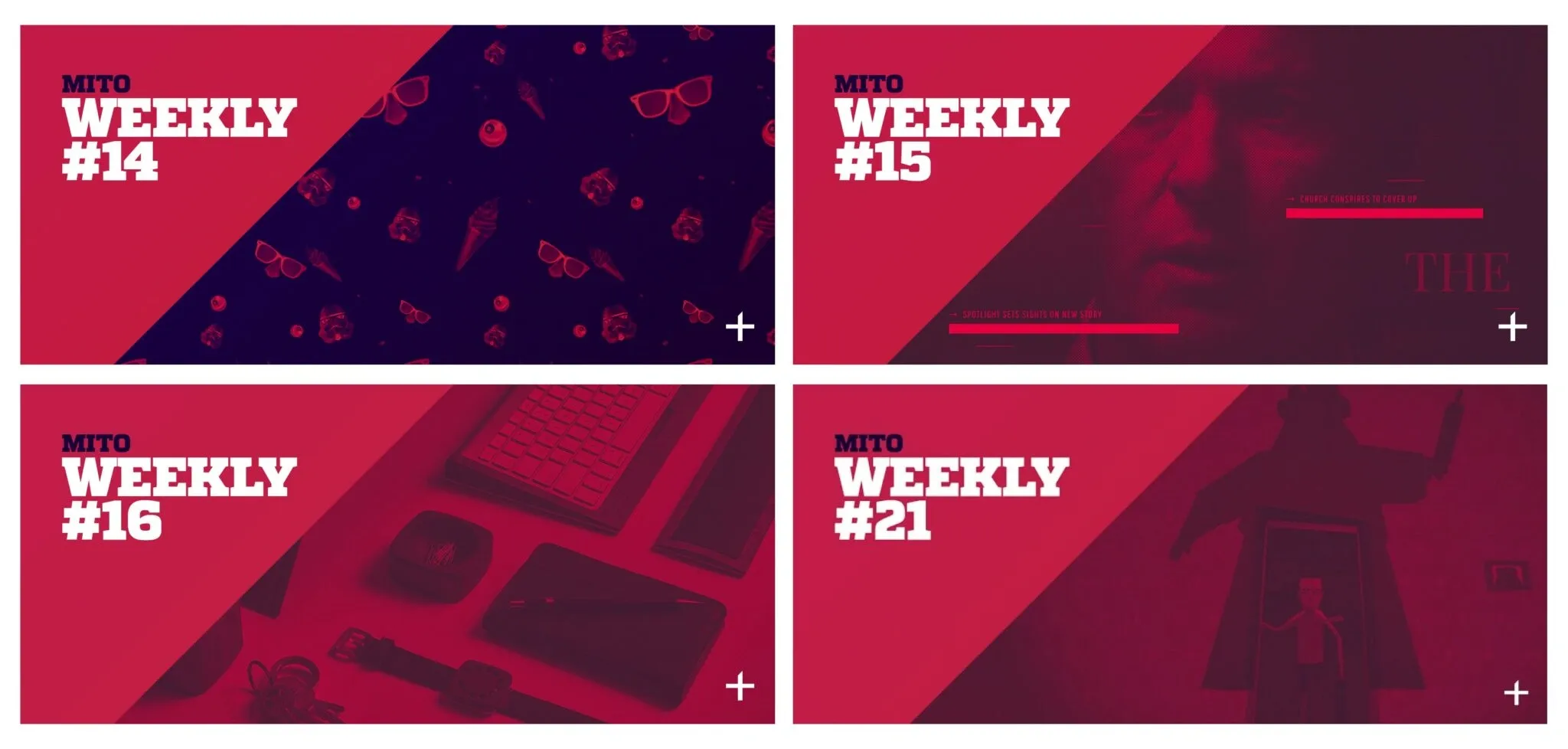
Cover photos of the very first Mito Weekly at the company blog
Since we have grown to love Weekly within the company, we figured we might as well show it to you. That decision marks the next important date, 9 March 2016, when we hit the Send button and delivered the first completely public newsletter campaign. But let’s not get ahead of ourselves!
Mito Weekly Belongs to All
We started to elaborate the public Mito Weekly concept in December 2015 already: we planned the landing page, the email template, the testing mechanism, the launch plan as well as the subscription flow.
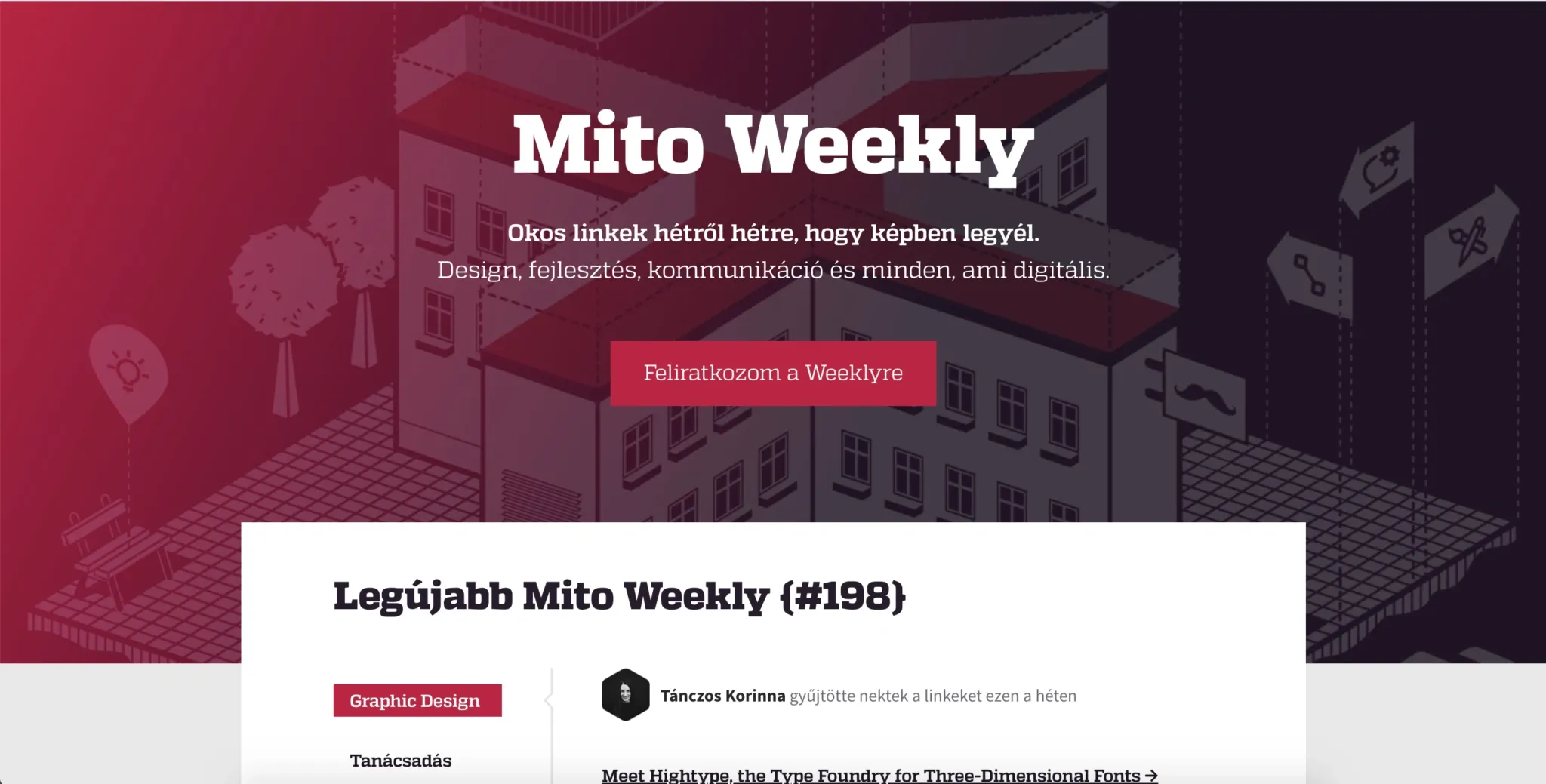
Our Weekly’s current landing page, still waiting for a facelift
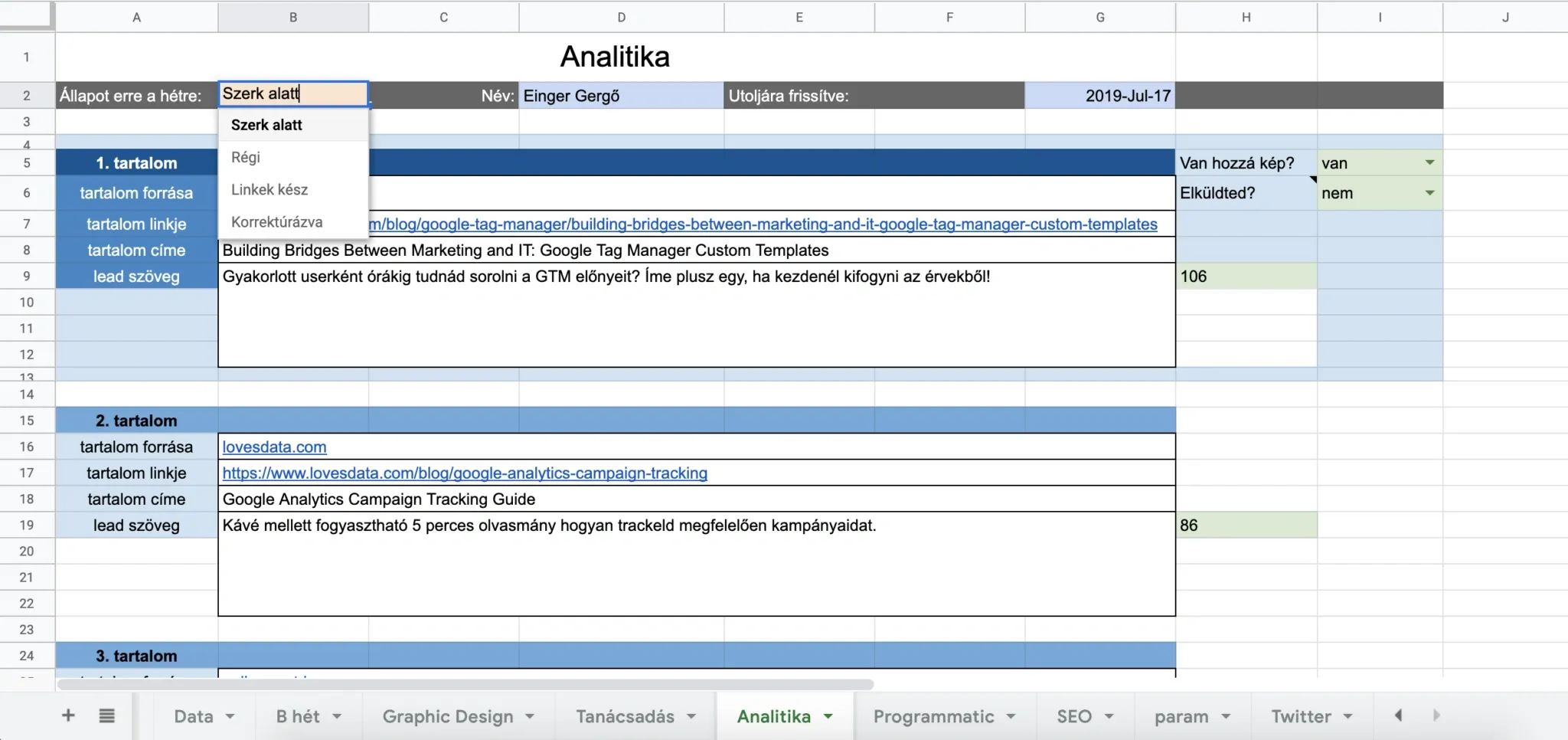
Meanwhile, we also devised the workflow in order to sync the work of content managers, proofreaders and the uploading of the MailChimp template with the incoming contents. We created an Excel sheet for the links, in which we collect materials to this day, as well as a guide, where we summarised the workflow and our content-related principles. (Each week, 8 or so people make sure that subscribers receive their dose of Weekly.)
The sheet in which we collect content from week to week
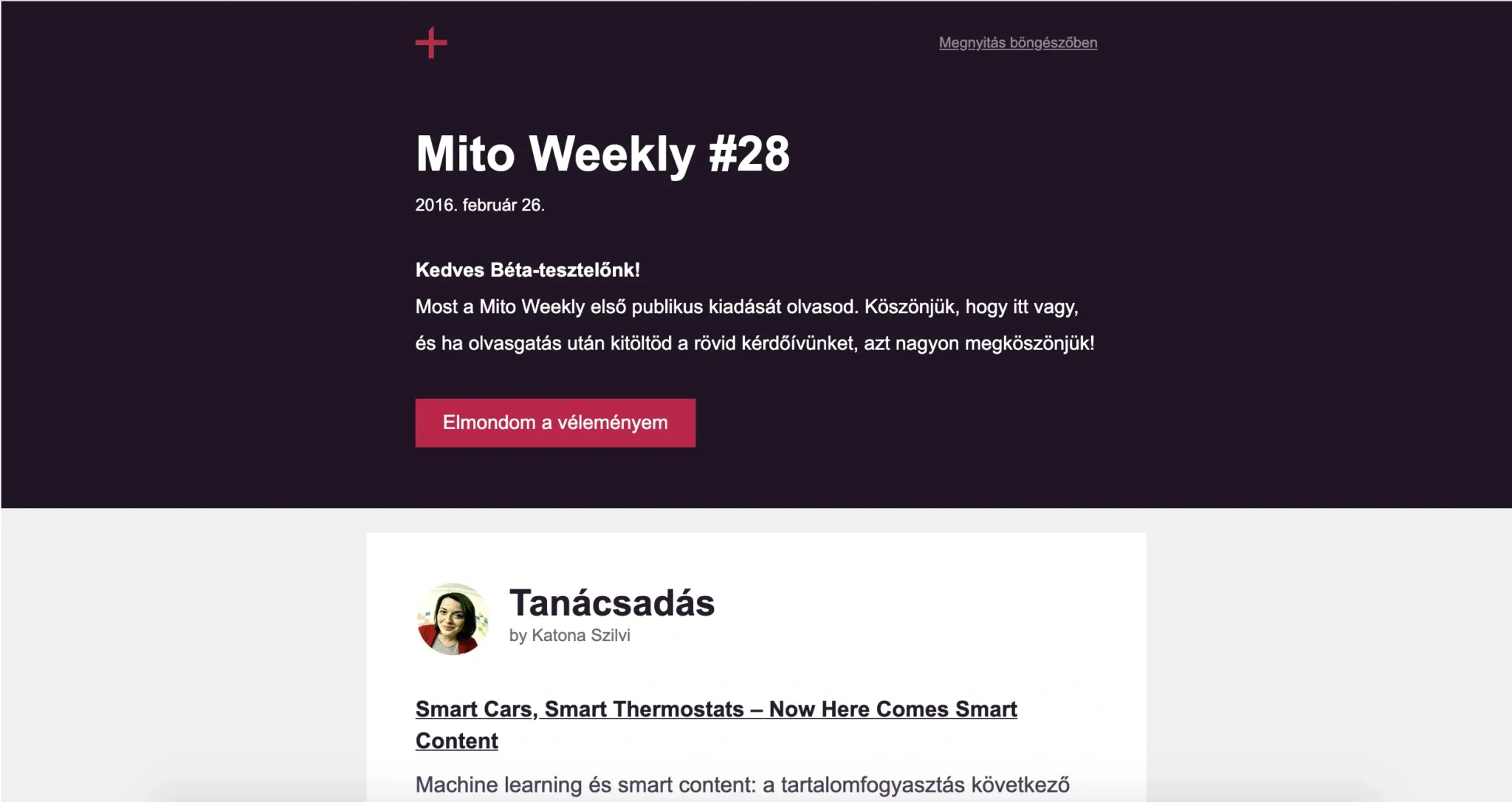
Before publishing the microsite and inviting people to subscribe to our newsletter, we sent Mito Weekly to our beta testers. Who were they? Close acquaintances, business clients and friends of Mito. Based on their feedback, we altered and fixed up a few things. For example, it was then that we reduced the number of links per division to 4, to make our selection easier to digest and more transparent. In addition, we also added sourcing to the contents which were to indicate the type of content as well (e.g. whether it is an article or a video).
One of our test emails
In the end, the Weekly became 100% public on 9 March 2016, so starting from that day anybody could subscribe to our weekly newsletter.
Later on we worked on the design and we constantly polish its appearance. You must have noticed that we had to introduce weeks A and B due to the sheer amount of interesting items that make it to our weekly collection.
How do we analyse it?
In order to improve Weekly even further, we analyse the statistics of the newsletter constantly. We use MailChimp to send out the newsletter, which contains a few basic statistics on the given releases and campaigns. We can check certain indicators by time series even a year back, but there is no full-scale information available on given topics. The MailChimp data does tell us which article is the most popular in a given issue, but it does not prove useful if we wish to get a holistic picture to set long-term strategic goals, or to see which topics interest you the most.
Consequently, we extract the data to a Data Studio dashboard using an API, where we scrutinise the posting statistics as well as the effectiveness of all contents, content types and authors on a weekly basis, based on our own criteria. We also gain insight into whether the order of the topics or even the order of the articles within topics matter.
What’s the best in Weekly?
We hope that every aspect of it. 🙂 At any rate, we are doing our best to make sure that you love every bit of it and that you always find something of interest in the given issue.
Now just for kicks let us share with you (as sort of a time capsule) what the most clicked links in 2019 looked like:
An Unsuitable Journey — M.J. Bale dressed a model in one of its finest suits, who was then sent on a 20,000-kilometre journey, going 5 days without sleep while wearing it for photo shoots.
Graphic Design
Landsec — brandbook — An online image guide of a British real estate company. This is the way to go. 🙂
Steven Mengin Portfolio — You wanna show what you’ve got or work with others, or just apply to a position? You might as well follow in the footsteps of Steven Mengin.
Budapest — Candidate City Olympic Games 2024 — Instead of incorporating a country’s coat of arms into an Olympic logo, why not go for the arms of the city instead? Makes a lot more sense.
Strategy
Brand Actions Library 2019 — A selection to truly inspire, check out this list of 200+ campaigns and 19 categories with the most intriguing campaigns of this year.
We analyzed 4 million data points to see… — The guys analysed the hell out of Reddit and they say that it takes 2 to 7 hours for a nobody to become an Internet sensation.
5 Consumer Trends for 2016 — At the beginning of each year, there is always a tsunami of lists telling us what to expect and what will drive the trendometer crazy. This list claims to be different from the rest. 2016 through a consumer’s eye… in three steps.
Radical Everything — OMG! It is well worth clicking on the link just for the visual richness of the site, but we can also learn how to be radical in 2019 in the good sense of the word.
…and how the Weekly has been done in the past 4 years. The fact that it got here and that we can always make it better is all down to you. So thanks for all you feedback and for being a faithful reader! And a huge shout-out to all of those at Mito who tend to Weekly while also doing their daily work. See you next Friday! ❤
If you don’t want to miss out on our next issue, then subscribe!